
Report on statistics of patent invalidation cases in China from the year of 2008 to 2018
February 3, 2019Author: Haiyang Zheng, Unitalen Attorneys at Law
Patent invalidation system means that where, starting from the date of the announcement of the grant of the patent right by the patent administration department under the State Council, any entity or individual considers that the grant of the said patent right is not in conformity with the relevant provisions of the Chinese Patent Law, it or he may request the Patent Reexamination Board (hereinafter referred to as the “PRB”) of the Chinese National Intellectual Property Administration (CNIPA) to declare the patent right invalid. The patent invalidation system is set for revoking the patent right granted to the invention-creations not satisfying the granting conditions under the Chinese Patent Law, maintaining fairness of the grant of patent right and protecting the public interests. In judicial practices at present, accused infringers would file request for invalidation of the patent involved nearly in every patent infringement case, which has almost become a “necessary link” in patent infringement litigation. Therefore, the patent invalidation procedure is of great significance to both the patentee and the public.
The PRB of CNIPA would regularly publish the decisions of invalidation that have been made, but it does not provide relevant data statistics or analysis on the decisions made in the past years. It is hard for the public to read the whole tendency and regularity from every single decision. Accordingly, the author of this report makes so bold as to sort and statistically process all the decisions of invalidation published on the official website of the PRB【1】, obtaining some data and herein sharing them for reader’s reference【2】.
I. Overview of Decisions of Invalidation
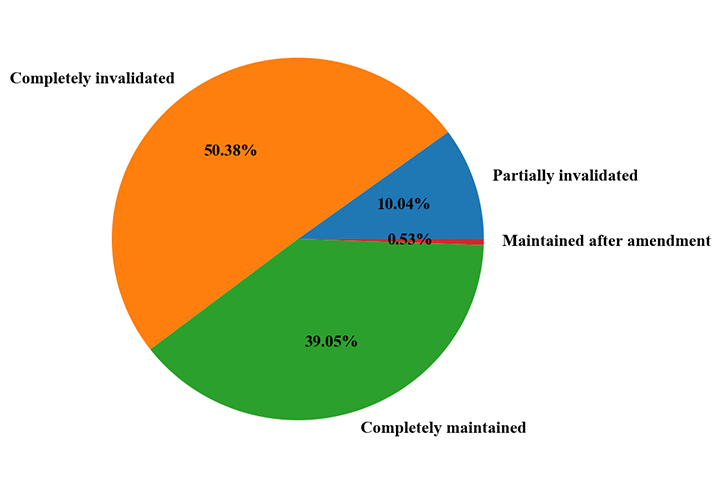
30,178 pieces of decision of invalidation (which, including those before 2008, at least have key information usable) are collected this time, wherein there are 15,203 pieces of decision of invalidation where the patent right is announced to be completely invalidated (hereinafter referred to as “completely invalidated”), accounting for 50.4% of the overall cases, there are 3,031 pieces of decision of invalidation where the patent right is announced to be partially invalidated (hereinafter referred to as “partially invalidated”), accounting for 10.0% of the overall cases, and there are 11,783 pieces of decision of invalidation where the patent right is maintained valid (hereinafter referred to as “completely maintained”), accounting for 39.0% of the overall cases, and there are 161 pieces of decision of invalidation where the patent right is maintained valid after amendment (hereinafter referred to as “maintained after amendment”), accounting for 0.5% of the overall cases. Accordingly, the decisions where the claims are at least partially invalidated account for over 60% of the overall cases.
1.1 Statistical data grouped by year
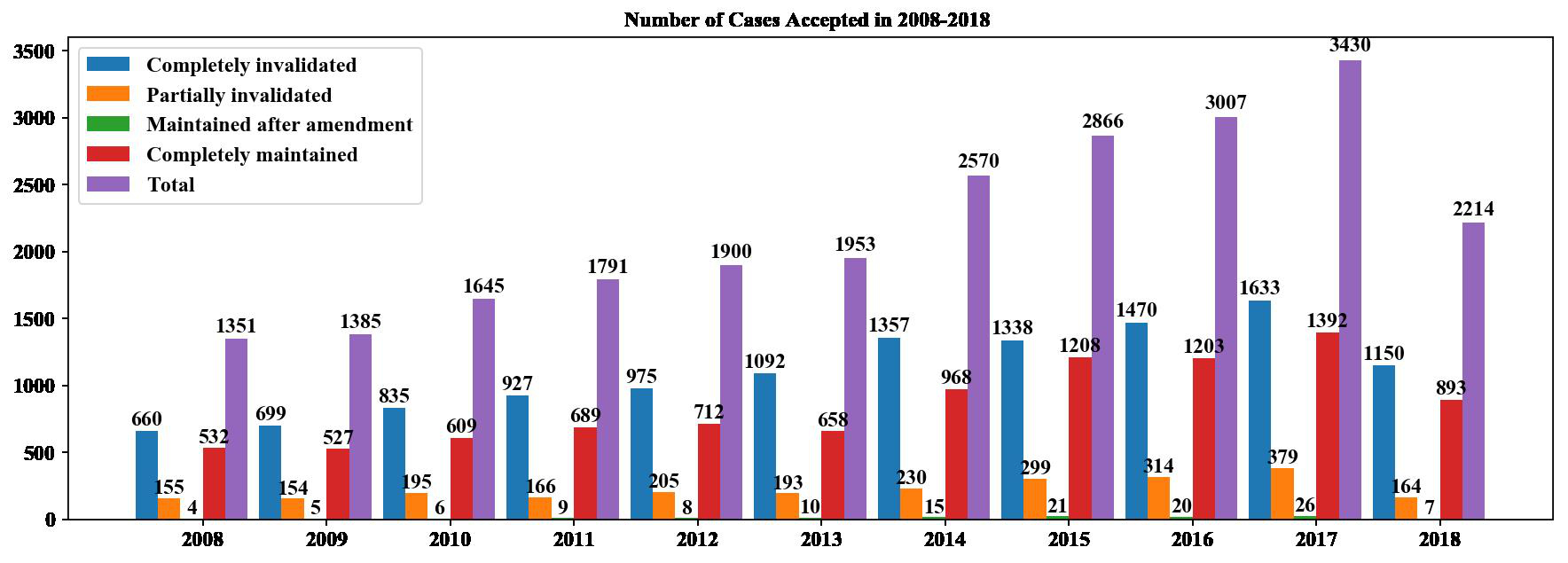
The above figure shows the number of the requests of patent invalidation accepted and closed from the year of 2008 to 2018. It follows that the number of the requests of patent invalidation has been increased year by year for the past ten years. About 50% of the cases accepted in each year were announced to be completely invalidated. Accordingly, counting the cases of being partially invalidated and those maintained after amendment, the decisions where the patent right is at least partially invalidated accounts for more than or almost equal to 60% of the accepted cases.
It should be noted that it seems the number of cases in 2018 is relatively less, but it cannot be simply deemed that the number of the requests for invalidation is reduced in 2018 since the possible reason is that there are many cases accepted in 2018 that are not yet closed.
1.2 Statistical data grouped by patent types

The table above shows the number of cases grouped by patent types. On the whole, the percentage of the invention cases as completely maintained is higher than the cases of design and those of utility model. The probability that the patent is announced to be invalidated is gradually increased in a sequence from the invention to the design to the utility model. This is consistent with the general inference, that is, the ratio of the cases of utility model being invalidated is much higher because of low stability of the cases of utility model. To some extent, the low stability of utility model patents has substantially increased the proportion of patents that have been declared invalid.
It can also be seen from the table above that the number of the requests for invalidation of invention is remarkably smaller than those of utility model and design, which is even less than half of the number of the requests for inva3 lidation of utility model.
II. Duration of Patent Invalidation Cases
2.1 Statistical data grouped by year
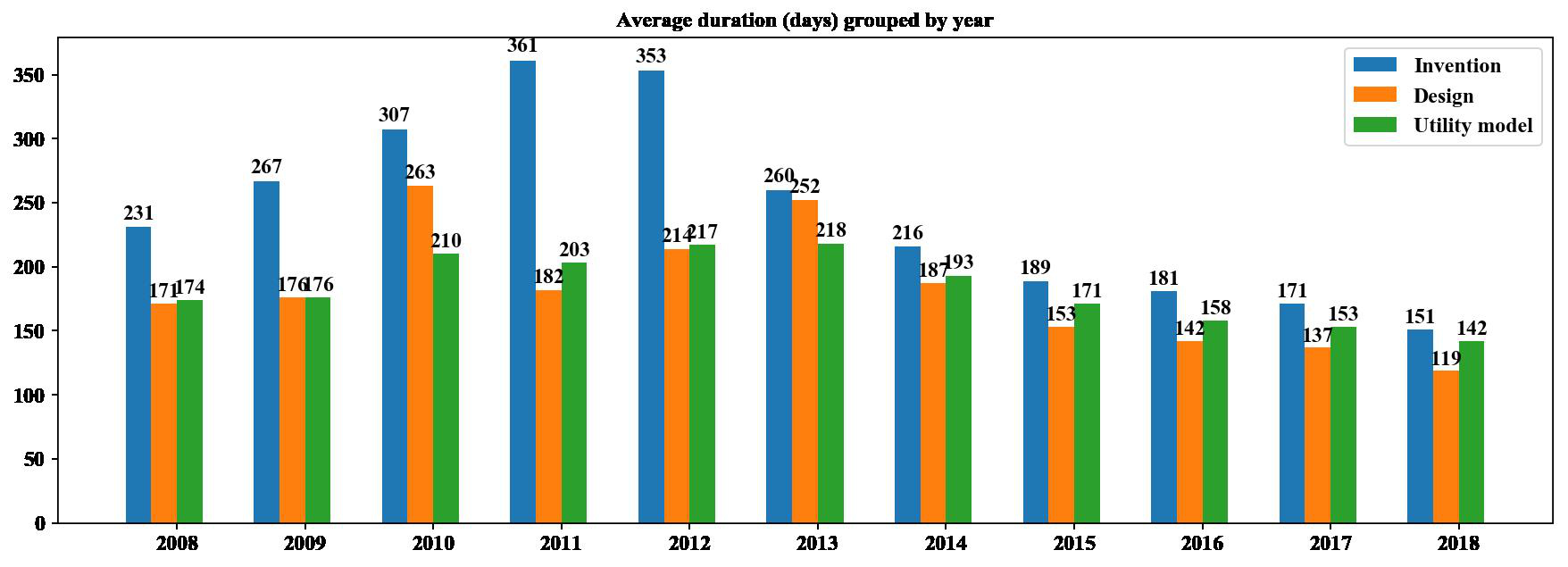
The above figure shows the average duration (days) of patent invalidation cases from the year of 2008 to 2018. As can be seen from the above figure,
(1) On the whole, the duration of the invalidation cases in each year substantially tends to be reduced from the year of 2011, which is maintained to be within about six months (180 days) after the year of 2015 and even reduced to be within five months in the years of 2017 and 2018. It should be noted that some time-consuming cases accepted in recent years are not yet closed or are being in the administrative litigation, which therefore are not published up to now. As a result, the actual duration of the cases accepted in recent years may be longer than that provided in the above figure.
(2) Regardless of the year, duration of invention cases is longer than those of the cases of utility model and design; generally, duration of design cases is the shortest.
2.2 Statistical data grouped by patent types
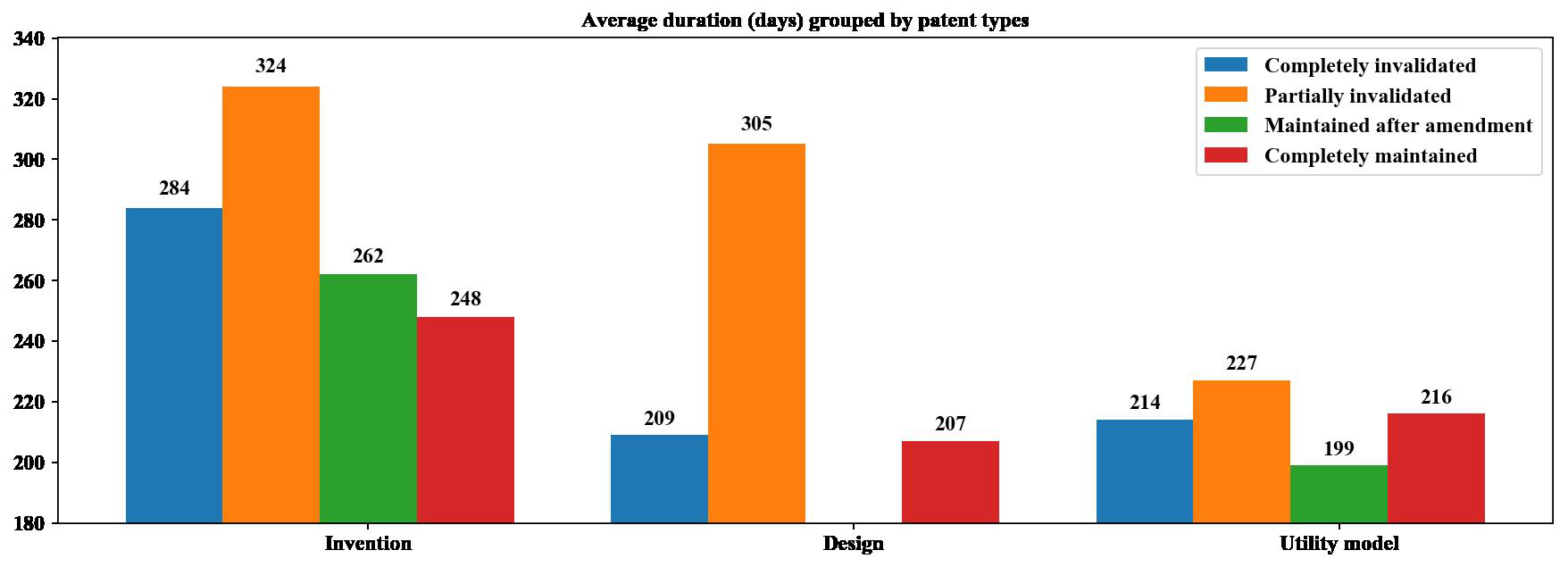
The above figure shows the average duration (days) of patent invalidation cases grouped by patent types. On the whole, average duration of invalidation cases of invention patent is longer than that of design patent and utility model, wherein making the decision of partially invalidation is the most time-consuming in each patent type. The possible reason is that, compared with the cases of completely maintained and those of completely invalidation, the cases of partially maintained may be much more complicated so that it takes more time to make the decisions.
The above duration on the whole is incredibly longer than that expected according to ordinary experiences. As to this point, the author of the report searched the most time-consuming cases, preliminarily determining that the cases with long duration (e.g., more than one year) all are involved in one or more administrative litigations, which is the reason for the long-time consumption. Top ten of the most time-consuming cases are hereby listed below for reference.

The duration would be considerably shortened if only the data of the years 2017-2018 are taken into account.
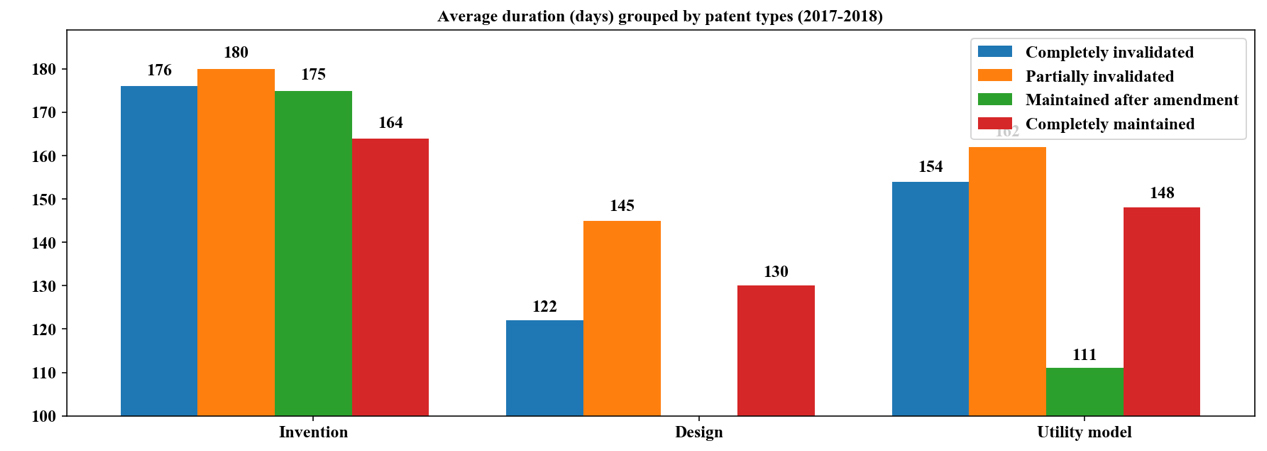
According to the data of the years 2017-2018, it can be substantially deemed that, regarding the cases except for those involved in administrative litigation or the like, it generally takes about six months for invalidation procedure of invention, about five months for that of utility model, and about four to five months for that of design.
III. Miscellaneous
Besides the above statistical information, some data of interest are also sorted and listed herein for the readers’ reference.
3.1 Patents subject to the most times of invalidation (Top eleven) (The same one No. of decision may correspond to a plurality of requests of invalidation)

Generally speaking, the times of filing request of invalidation against a patent is in positive proportion with the patent stability (an unstable patent would not be subject to invalidation for many times since it could be invalidated easily) and the patent value (a low-value patent is not worthy of the costs consumed by petitioners). In the patents listed in the above table, the ratio of utility model and that of design are not smaller than the ratio of invention. Accordingly, the patents for utility model and design drafted at a high level can also have value not lower than the patents for invention.
3.2 Number of invalidation cases grouped by classification code and ratio of completely maintained cases
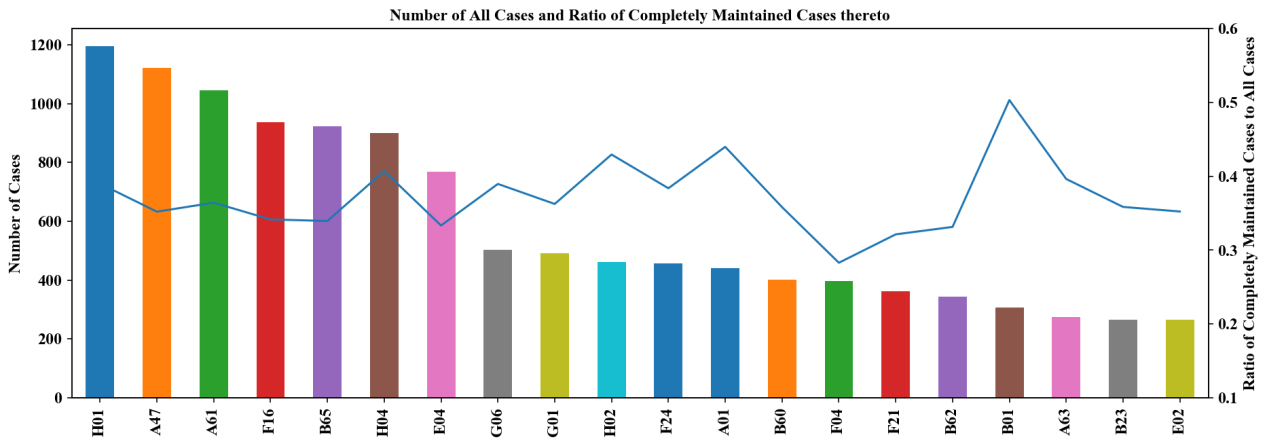
The above figure shows number of cases grouped by classification code (taking only the first three number of each case) and ratio of completely maintained cases thereto. As can be seen from the figure, as to the number of the cases, the top three classes are H01 (basic electrical element), A47 (furniture; household items or equipment; coffee mills; spice mills; general vacuum cleaners) and A61 (medical or veterinary science; hygiene), each of which involves over 1,000 cases.
Besides, as can be seen from the above figure, the ratio of completely maintained cases varies with different classes. The classes【3】 where the ratio of completely maintained cases is more than 50% and those lower than 30% are listed below for reader’s reference.
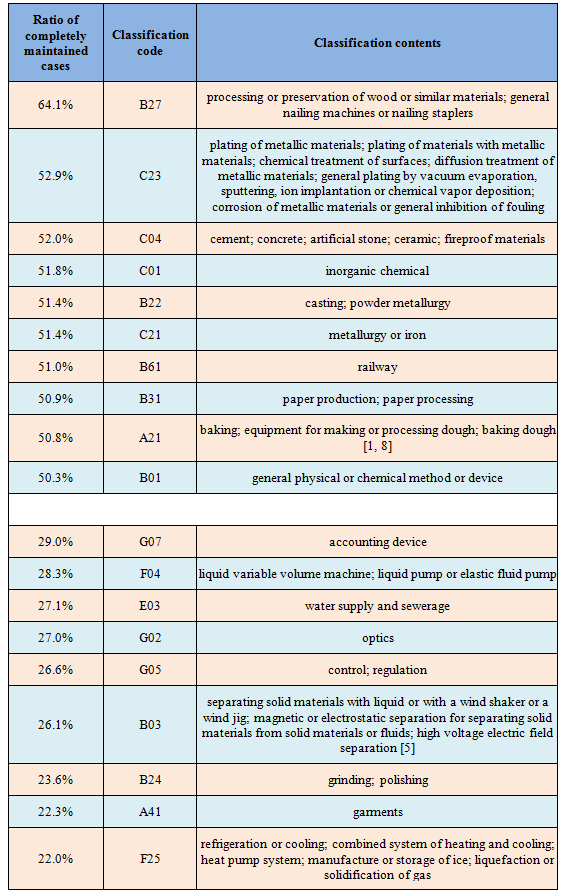
On the whole, the invalidation cases in such basic fields as inorganic materials (e.g., wood, metal, and cement) and processing thereof (e.g. plating, and surface treatment) have a relatively high ratio of completely maintained cases. The invalidation cases in such specific application field such as optoelectronics have a relatively low ratio of completely maintained cases.
Notes:
【1】 Refer to http://app.sipo-reexam.gov.cn/reexam_out1110/wuxiao/wuxiaolb.jsp
【2】 It should be noted that the data published on the official website of the PRB per se have some problems (e.g., some decisions, especially those issued at early stage, are subject to information missing or error). Consequently, some data with error or those not usable are deleted in the statistical process. The statistical data are concentrated upon the decisions published from the year of 2008 to 2018. Due to the deletion of some decisions and the possible deficiency of the programmed algorithm, the statistical result below would be of error to a certain extent. Besides, since a decision of invalidation cannot be issued unless the invalidation case is closed, the cases not closed are not counted into the following statistical analysis.
【3】Considering the cases with a small number is statistically meaningless, the classification here only involves the cases with a number of more than 50.
Keywords
Headquarters
Add(Beijing):7th Floor,Scitech Place,22 Jianguomenwai Avenue,Beijing 100004,China
Tel: +86 10 5920 8888
Fax: +86 10 5920 8588
E-mail: mail@unitalen.com
Newsletter
Do not miss out on the latest announcements we've provided
Networking



Unitalen Mail Box ?2016 Unitalen Attorneys at Law 版權所有 集佳知識產權代理有限公司 京ICP備11033076號 京公網(wǎng)安備11010502020670